
Niagara Falls Can Power Forward With Data Center Opportunity
By Tony Farina
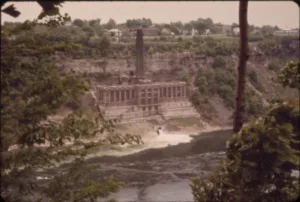
While Niagara Falls, N. Y., is known far and wide for its beauty and natural world wonder, the real story of its incredible journey is about power where more than 100 years ago that power helped change the world when the Adams Power Plant was built in the late 1800s, just a couple hundred feet from where a new data center is being proposed today.
Adams Station -Historic view of the Adams power complex on Buffalo Avenue, showing the scale and permanence of the industrial buildout.
And indeed the location matters today.
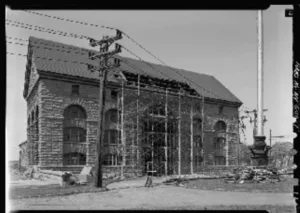
The power plant was one of the first on earth to generate large amounts of electricity and send it miles away. Using ideas from Nikola Tesla and built by George Westinghouse, it proved something new: power could travel—and industry could follow. And it did.
Factories rushed to Niagara Falls and along Buffalo Avenue, major companies like Hooker Chemical, DuPont, Union Carbide, and others built massive operations. They used electricity to produce chemicals and materials that helped build the American economy.
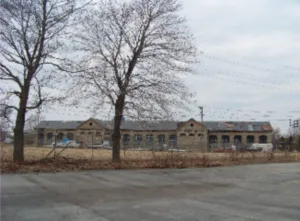
But that wasn’t the whole picture. Just inland, in what was once known as Quay Street, now John Daly Boulevard—a different kind of industry grew. This was not heavy manufacturing, it was lighter, supporting work like warehouses, paper- related operations, storage yards, and fabrication shops.
It became the corridor where companies like Moore and other local businesses operated. They supported the larger plants nearby and were part of the same system—just a different layer of it.
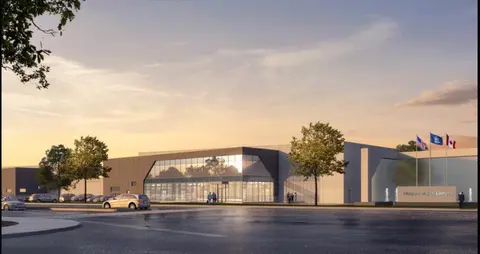
All this history is important today because the proposed $1.5-billion data center proposed by NFR—which already owns much of the land—would sit right in that same footprint. Always a working corridor, the site remains part of an active service and infrastructure area—separated from the Niagara Falls wastewater treatment plant by the Community Missions campus and the State Parks maintenance facility. These are exactly the kind of uses that belong in a light industrial corridor. Nothing about this location is new or out of character.
What’s changing is not the land but how power is used. Today it powers computers. In the past electricity made chemicals and paper and today it powers computers.
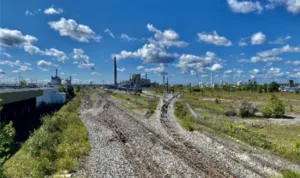
The proposed data center, or as it is known the Niagara Digital Campus, would have a huge economic impact expected to create, for example, 5,600 construction jobs, 550 permanent high-paying positions, and an estimated $414 million in tax revenue over 20 years.
A data center is not a factory in the old sense. It looks more like a large office building where inside there are rows of computers, stacked like shelves in a warehouse. They store and process information. They power websites, apps, and artificial intelligence.
There is no smoke, no assembly line, no heavy industry. It is quiet, clean, and controlled. It depends on one thing: power. That is why Niagara Falls still matters. The same power that brought factories here long ago can now support this new kind of use. And it is certainly much needed in a severely struggling city with a declining tax base and a short tourism economic engine.
Now is the time for Niagara Falls to tap into its access to power to generate a new start at last. Land has simply been valued based on location, but that framework is outdated. Today, the value is increasingly tied to access to power, transmission capacity, and infrastructure readiness. It redefines how land is priced, how projects are evaluated, and ultimately how communities grow their tax base.
A data center does not just occupy land—it activates the full value of the resources surrounding it. This is not short-term development. It is asset revaluation. This land use begins to align land use with that power advantage.
As we began this piece, we wrote about how Niagara Falls powered the first wave of industrial growth. Today, it has the ability to support the next phase—where power is converted not into materials, but into data, computation, and economic output. The opportunity is there.