Senecas Unlikely to Resume Payments to City of Niagara Falls Voluntarily

Please click the link below to subscribe to a FREE PDF version of each print edition of the Niagara Reporter
http://eepurl.com/dnsYM9

By: Tony Farina
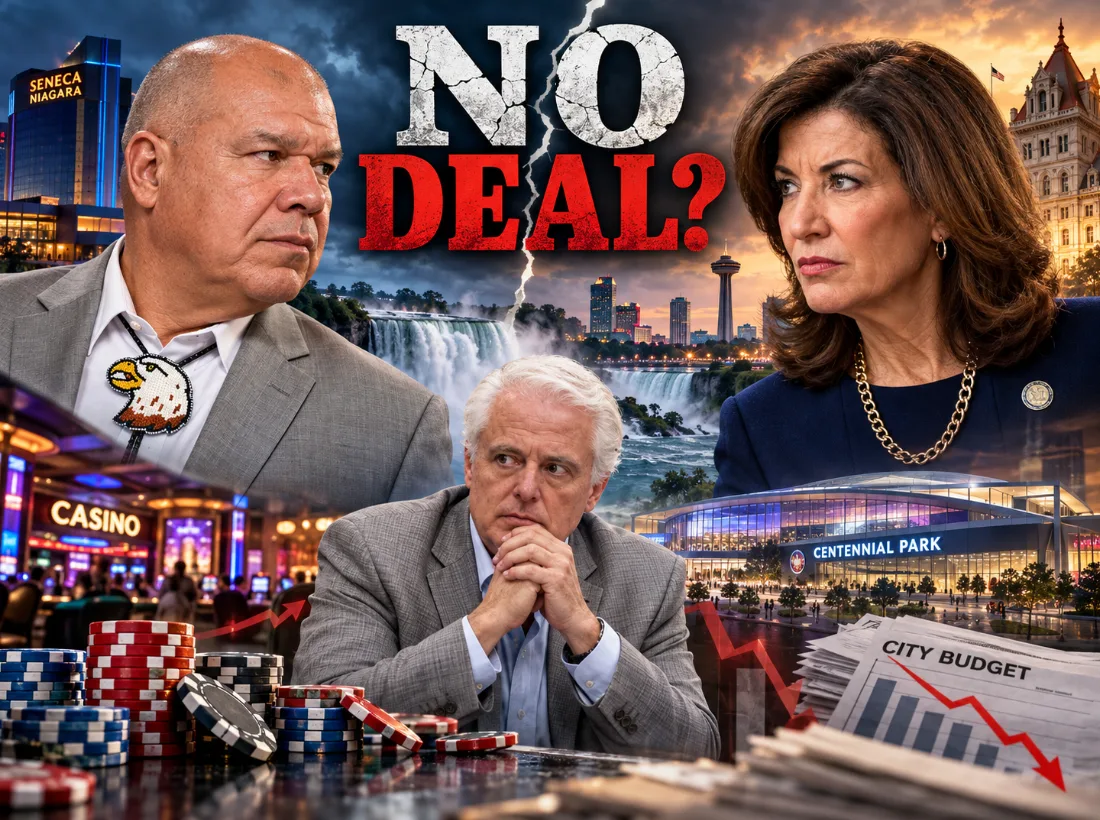
If the Senecas continue to hold their cards on resuming their casino payments to the state which they stopped in 2017, the three host cities, including Niagara Falls, will continue to lose an important revenue source which all had been planning on after last January’s arbitration ruling in favor of the state.
Niagara Falls borrowed slightly more than $12 million from the state to balance the 2019 budget in anticipation of receiving the revenue sharing payments, but as of this writing, the Senecas are silent on their plans and when, or even if, they will resume payments remains questionable.
“We would start to feel the pinch in the third quarter of the year,” says Niagara Falls Council Chairman Andrew Touma when asked about the latest delay in revenue sharing payments. But Touma cautioned that right now, anyway, the city can only wait and hope.
The Senecas have paid New York State more than $1 billion between 2002 and 2016 under the gaming compact, a 25 percent share of slot machine revenue with 25 percent of that money passed on to the host cities. But the Senecas stopped payments in 2016, saying they had fulfilled their obligation under the compact and no more revenue sharing was written into the 2016 extension.
The state challenged the Senecas on their decision to stop payments and won the arbitration by a 2 to 1 vote that from the beginning did not sit well with the Seneca Nation, and they have been publicly silent ever since.
But sources say the Senecas are waiting for an official order from the arbitration panel, expected shortly, on what they should pay the state to cover the missing payments which is expected to be in the $200 million range. That order could trigger a further challenge from the Senecas who sources say are not planning to write a check anytime soon. They could, sources say, mount a revenue sharing challenge under the Indian Gaming Regulatory Act alleging they aren’t getting a meaningful return on their exclusivity protection from the state.
While not directly parallel to what’s happening in New York, a federal judge in New Mexico issued a decision last week that sided with six tribes in a dispute over gaming revenues in that state.
New Mexico had sought upwards of $60 million from the tribes, claiming they owed the money for “free play” at the casinos, but the judge rejected the argument. The judge said in part the additional revenue sharing being sought by the state did not satisfy requirements of the Indian Gaming Regulatory Act “because they are not payments made pursuant to a bargained for and agreed-upon compact provision for which meaningful concessions were offered in return.”
John Kane, a Mohawk living on the Seneca Nation’s Cattaraugus Reservation, is a well-respected native rights activist and radio talk show host. While he doesn’t speak for the Senecas, Kane offered this insight into the current impasse:
“The Senecas have a strong case for challenging revenue sharing in spite of the arbitration ruling. That is to make the question about the legality of revenue sharing under the Indian Gaming Regulatory Act (IGRA) rather than just a state gaming compact issue.”
Kane went on to say that “If the Interior Department is called upon to determine if the Senecas are being forced to relinquish revenue for little to no concession from the state, it is hard to imagine the state prevailing. Of course, the 800-pound gorilla in the room is whether the Senecas can overcome any fear of retaliation from the state, such as ending its gaming compact with the Senecas and what effect that would have.
“In the past, there has been an unwarranted assumption that since Native Class II gaming under the IGRA requires a state compact, that a state could shut down a native casino by simply canceling its compact. That certainly was never the intent of the provision and there is no precedent establishing the amount of state power.”
So there you have it. When the arbitration panel rendered its opinion, the one vote against the ruling came from a Chickasaw Nation citizen, a former head of the Bureau of Indian Affairs under President Obama.
Kevin Washburn voted in favor of the Senecas, saying the panel essentially rewrote the terms of the agreement.
The Senecas may well decide to challenge the panel’s ruling, casting doubt on resumption of the payments anytime soon. The state, meanwhile, is proceeding as if the payments will resume, although the Senecas have not publicly or privately hinted that the check’s in the mail.
Stay tuned for what could be another long battle over the gaming compact that has paid huge dividends for the state and the host cities, but also caused near-catastrophic panic with the two gaming wars that apparently have not yet finally settled.