By Frank Parlato
A privately funded campus would draw on hydropower four miles away, build its own substation, and return $414 million to a city designated as disadvantaged.
NIAGARA FALLS, N.Y. — A $1.5 billion private investment proposed for 53 acres in the heart of Niagara Falls would deliver 550 permanent jobs, more than $400 million in tax revenue, and a modernized electrical backbone for a city the State of New York has formally designated a Disadvantaged Community — without a dollar of public money for the grid.
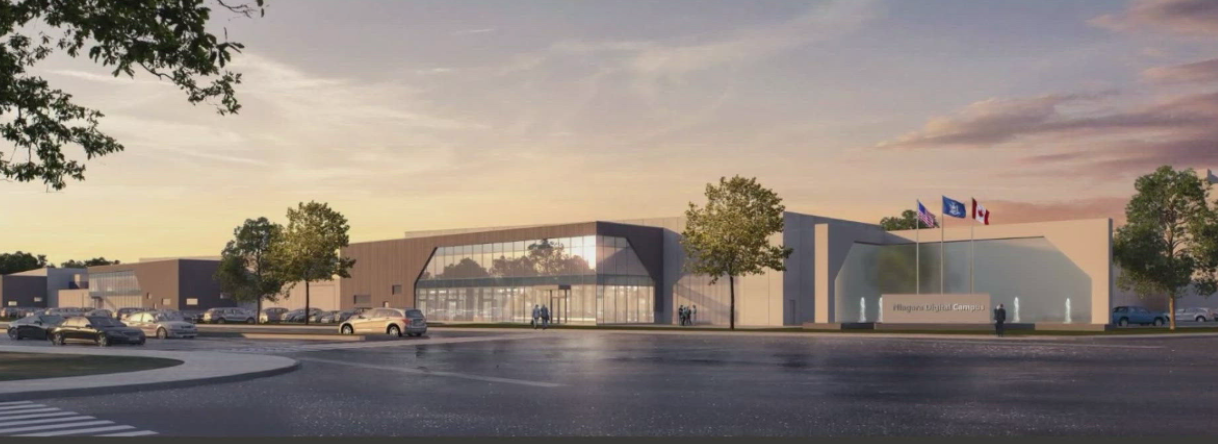
The Niagara Digital Campus, proposed by Niagara Falls Redevelopment in partnership with the Toronto-based data center builder Urbacon, sits on land the company already owns. Under a settlement approved by the Niagara Falls City Council on June 3, NFR will design, construct, and operate the electrical substation that powers the campus at its own expense.
The project’s profile addresses, point by point, the concerns Gov. Kathy Hochul cited on July 14 when she signed Executive Order 62, which paused state environmental permits for large data centers.

The economics
An economic impact analysis prepared by MRB Group projects $414 million in new tax revenue over 20 years: $298 million to the City of Niagara Falls and its school district, $54 million to Niagara County, and $63 million to New York State. The analysis puts property taxes at roughly $7 million annually and the energy sales tax at $3 million to $5 million annually.
For the average Niagara Falls homeowner, MRB estimates the effect at $730 in tax savings per year.

Click here to learn about Nate!
The campus would create 550 permanent positions — electricians, engineers, analysts, network and security professionals — with an additional 1,700 jobs in supporting businesses. Construction would generate more than 5,600 jobs during the buildout. Across two decades, MRB projects 19,000 job-years, more than $1.6 billion in wages, and roughly $250 million in annual economic activity.
“Done right, this initiative will bring an unprecedented level of economic opportunity to a city where it’s desperately needed,” said Dennis Elsenbeck, a consultant to the project and the former regional director for Western New York at National Grid.

The power
The Robert Moses Niagara Power Plant stands four miles from the site, producing roughly 2,600 megawatts of carbon-free electricity — eighteen times what the campus would draw. The generation exists. It has since 1961. No new supply must be procured and no new plant must be built.
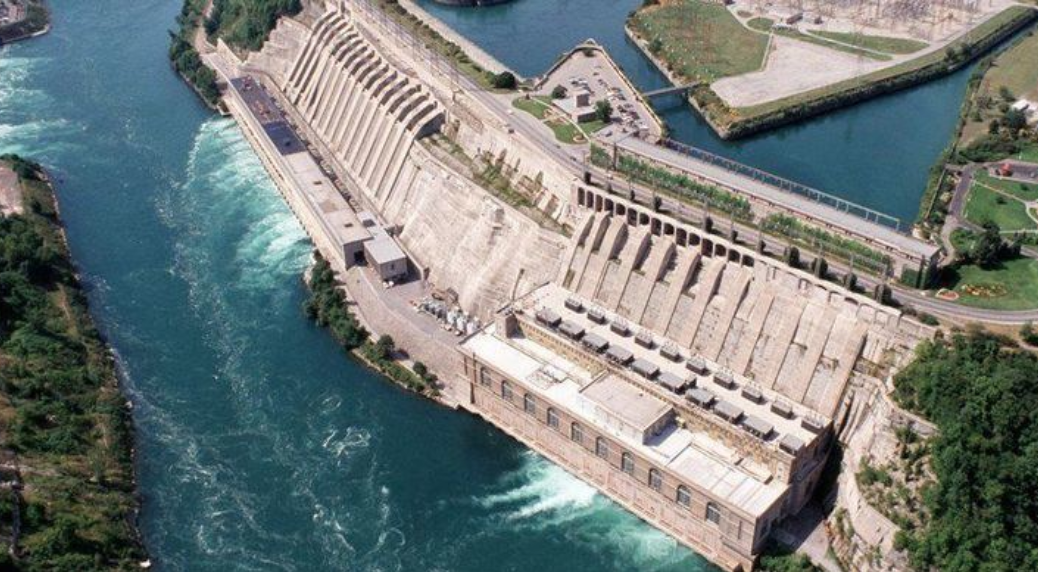
Niagara Falls paid for that plant with its own economy. When the Schoellkopf station collapsed into the gorge in 1956, the city lost tens of thousands of regional jobs and nearly a quarter of its tax base — the Power Authority’s own account. The state built the largest hydroelectric facility in the Western world on the wreckage.
Ten percent of the output leaves for seven other states by act of Congress. Six hundred megawatts of transmission rights carry Niagara power downstate to serve New York City.
Elsenbeck said the campus would broaden the region’s ratepayer base and put downward pressure on future electric rates. “This is how you broaden the ratepayer base,” he said. “How you stabilize electric rates.”
The northern climate reduces mechanical cooling. Peter Russell, Urbacon’s vice president of properties and development, called Niagara Falls an ideal location, citing ready access to hydroelectric power and a climate that allows quieter, more energy-efficient operations.
The review
Executive Order 62 directs the Department of Public Service to prepare a Generic Environmental Impact Statement examining data centers as a category, a process expected to take up to a year. The order does not apply to permits issued by local governments.
The site-specific review the order suspends is the one that examines actual equipment. The Department of Environmental Conservation reviews air permits project by project: how many generators, what engine tier, how many testing hours, what the emissions total, what the sound level is at the property line. The application is published. The public comments. Under the Climate Act, DEC must weigh the burden on a disadvantaged community before issuing anything.
NFR has said it will meet that review. A campus-by-campus examination is the one that produces enforceable conditions on a specific site. A category-wide study does not.
The context
In March, the New York Power Authority board awarded Amazon roughly 10.7 megawatts of low-cost Niagara hydropower for a $550 million warehouse in the Town of Niagara. The same round directed 140 megawatts to Micron in Onondaga County. The governor’s office announced both.
“The legacy of Niagara hydropower is deeply intertwined with economic growth and vitality of Western New York,” NYPA Chairman John R. Koelmel said at the time.
The June 3 settlement also transferred 10 acres to the city for Centennial Park, and the arena that Mayor Robert Restaino has pursued for years. That land came from NFR.

Mike Elmendorf, president of Associated General Contractors of New York State, told Engineering News-Record that a year-long permitting halt in a fast-moving sector would not delay projects but “send them permanently to Virginia, Texas, Georgia,” and other competing states.
New York designated Niagara Falls as disadvantaged. The Niagara Digital Campus is the largest private proposal to change that condition in the city’s modern history.