Uncertainty Over Casino Revenue Sharing Is Serious Issue for Centennial Park Project
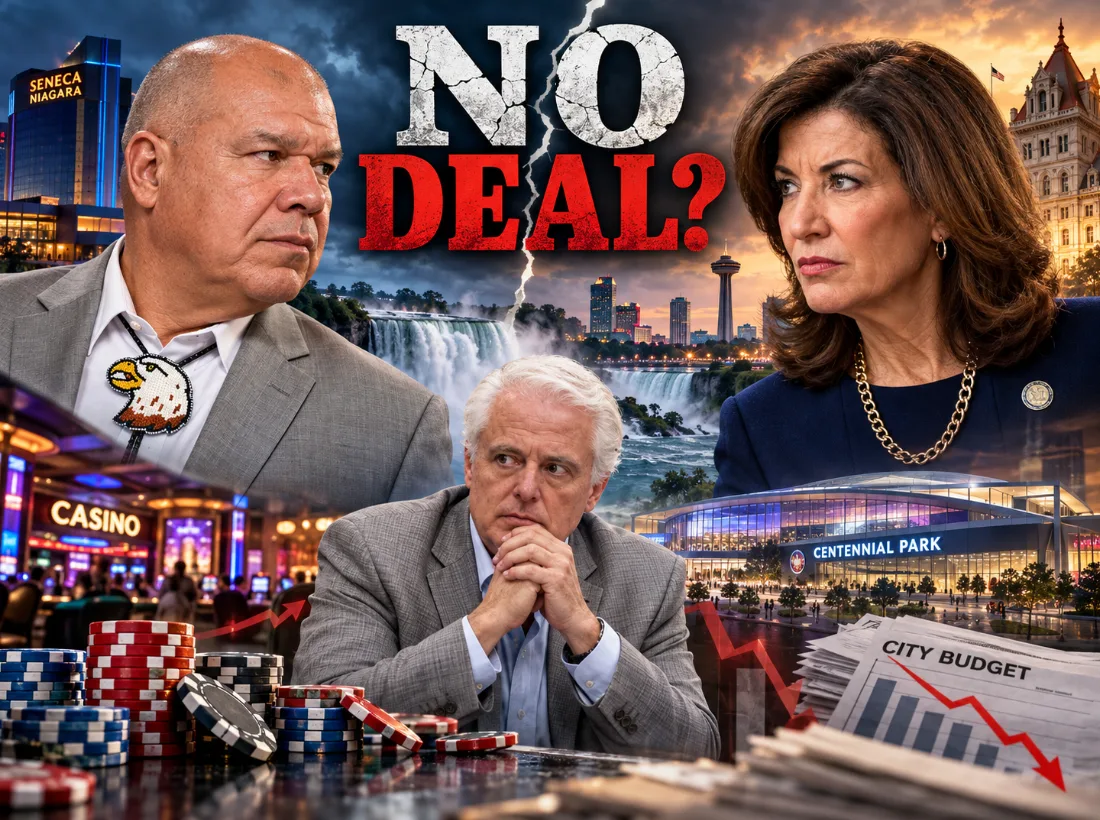
As of this writing, according to Gov. Kathy Hochul there is “no deal” between the State of New York and the Seneca Nation on a new gaming compact even though the Seneca Nation President J. C. Seneca said recently there was an agreement in principle between the two sides that would not include revenue sharing to the three casino host cities, including Niagara Falls.
The uncertainty on the revenue sharing piece throws a big wrinkle in the city’s plans for a $250 million-plus Centennial Park entertainment and sports complex because with no slot revenue sharing, Niagara Falls could lose the $11 million to $13 million in casino revenue it receives each year.
Mayor Robert Restaino has said casino revenue represents nearly 10 percent of the city’s approximately $100 million annual budget and losing money from revenue sharing without replacement funding from New York State would not be a minor adjustment. It would create a substantial recurring financial challenge that the city would have to address every year. The uncertainty hanging over revenue sharing and state support if it doesn’t continue in a new gaming deal must now be part of the Centennial Park deliberatons.
The issue is not simply whether Niagara Falls can construct the facility. The larger question is what financial responsibilities the city could ultimately assume for its construction, financing, operation, and long-term maintenance.
The City Council is currently considering creation of the Niagara Falls Entertainment and Sports Complex Local Development Corporation, or LDC. That entity would be responsible for developing, financing, constructing and operating Centennial Park.
Importantly, council members recently postponed action on creation of the LDC until at least Nov. 4 while they continue discussing its structure. Among the issues reportedly under consideration is language defining the division of financial responsibility between the city and the LDC.
The uncertainty surrounding casino revenue makes that distinction even more important. If Niagara Falls loses $11 million to $13 million annually in casino revenue and New York State does not replace it, the city’s ability to assume financial responsibility for Centennial Park becomes substantially more constrained.
Any Centennial Park financing plan would need to demonstrate that construction debt, operating deficits and long-term capital obligations can be met without relying on a City General Fund that is simultaneously absorbing the loss of approximately 10 percent of its existing revenues.
All this does not mean Centennial Park cannot proceed. It does mean the financial assumptions supporting the project deserve another examination under the circumstances that may be substantially different from those that existed when the project was first proposed.
There are several questions that should now be answered. Will the LDC be entirely responsible for Centennial Park debt, or could any portion ultimately become a City obligation? Will the city guarantee any borrowing? Could the General Fund be required to support the facility if revenues fall below projections?
Who will pay for future capital repairs and improvements? More importantly, can Centennial Park remain financially viable if the city receives no casino revenue?
The questions raised here should be answered before long-term commitments are made. Niagara Falls has experienced casino revenue uncertainty before. The city’s own audited financial statements document the disruption that occurred when revenue-sharing payments stopped between 2017 and 2021 during the previous dispute between the Seneca Nation and New York State.
That history demonstrates why dependable recurring revenues matters when a municipality considers long-term obligations.
The current situation is not yet settled. While Seneca President J. C. Seneca said the agreement in principle with the state presently contains no revenue-sharing provision, he has also said Nation advocated during negotiations for continued funding for Niagara Falls, Buffalo and Salamanca.
The Hochul administration has characterized negotiations as ongoing, and any new compact would ultimately require additional government action. New York State could therefor create another mechanism to provide Niagara Falls with replacement funding. If Albany guarantees Niagara Falls an equivalent and dependable revenue stream, the financial picture could look considerably different. But until that happens, the city should plan around what is known rather than what is hoped for.
There is a straightforward way to accomplish that.
Before Niagara Falls assumes significant financial responsibility for Centennial Park, the city and the proposed LDC should produce a financial model that assumes zero casino revenue is available to support the project.
The model should identify the source of every dollar required for construction, annual debt service, operations and long-term debt capital maintenance. It should also demonstrate what happens if attendance, sponsorship, event or other projected revenues fall below expectations. If state assistance or other dedicated revenues are ultimately secured, then they can strengthen that model.
The wrinkle on uncertainty over casino revenue sharing cannot be ignored. And if the loss becomes real, who bears the responsibility if projected revenues do not materialize.
Before Niagara Falls commits to the project, taxpayers deserve answers.