
Harshest arctic air of season grips midwestern, eastern US
AccuWeather Global Weather Center – January 18, 2016 –
AccuWeather reports brutal cold will sweep into the eastern U.S. through early this week and will continue to leave its mark in the Midwest.
The new arctic blast will be the harshest the Midwest and East have experienced so far this season.
According to AccuWeather Chief Long-Range Meteorologist Paul Pastelok, “The arctic deep freeze will last two to three days in most places.”
Parts of eastern North Dakota, Minnesota and northeastern Iowa will not have temperatures climb above zero until Tuesday, making for a total of 72 hours of subzero readings since the weekend started.
Temperatures dangerously dropped under 10 below zero degrees Fahrenheit on Sundaynight and will do so once again on Monday night in and around Minnesota. Some communities near the Canadian border will register lows below minus 20.
AccuWeather RealFeel® Temperatures will be life-threatening if people venture out without being properly dressed from the northern Plains to the Ohio Valley.
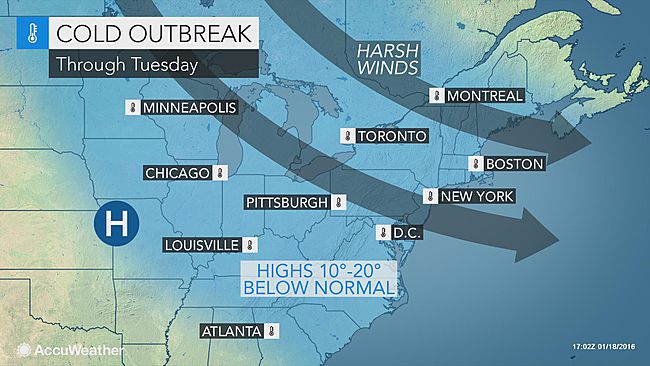
The cold in the Eastern states will not be as brutal as that of the Midwest. However, temperatures will be 10-15 degrees below average for a couple of days.
Subfreezing highs and biting winds will encompass the I-95 corridor in the Northeast and mid-Atlantic through Tuesday. This swath has not experienced air feeling this cold so far this winter.
“Washington, D.C., has not had a day during which temperatures stayed below freezing all day [so far this season],” AccuWeather Meteorologist Dave Samuhel said. “However, the city will have two such days Monday and Tuesday.”
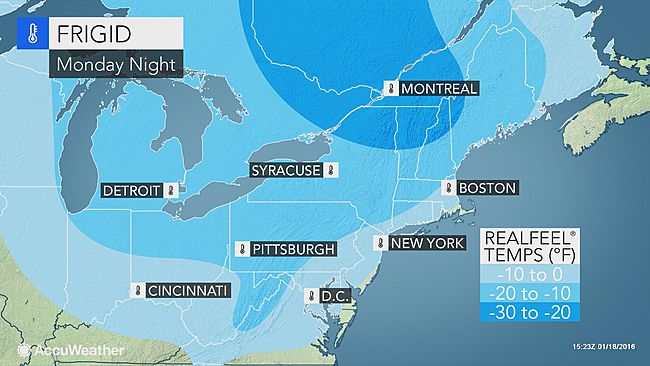
The winds will create significantly lower RealFeel® Temperatures in the Northeast and mid-Atlantic, which will bottom out down to or below zero to the I-95 corridor Tuesdaymorning.
“Residents in the Southeast will also be shivering from this arctic blast,” Samuhel said.
“In Raleigh, North Carolina, temperatures on Monday will be struggling to reach the mid-30s with a gusty winds making it feel closer to 20 much of the day.”
On Tuesday, temperatures will barely rise to near 50 in Jacksonville, Florida.
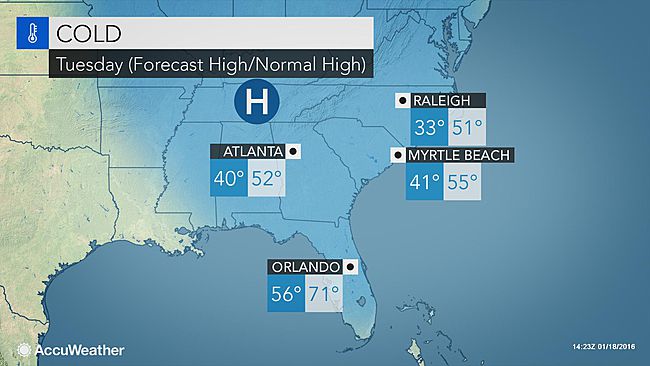
Highs in the Southeast in mid-January typically range from the lower 50s around Raleigh to the mid-60s in Jacksonville.
“The cold air will blast through parts of Florida recently affected by severe weather,” said Samuhel. “Interior parts of South Florida will flirt with the upper 30s Monday night.” Similar temperatures will follow for Tuesday night.
However, freezing nighttime temperatures will remain north of the major citrus areas.
When the arctic air settles over the East through Tuesday, most of the snow will be confined to places downwind of the Great Lakes and the northern Appalachians. Significant lake-effect snowfall is expected.
The harsh cold will ease across the Midwest and East beginning at midweek. However, enough cold will be in place for snow to spread from the central Plains to the Ohio ValleyTuesday into Wednesday.
While this snow will likely fizzle east of the Appalachian Mountains, another storm has the potential to bring a heavy accumulation of snow to the mid-Atlantic and perhaps southeastern New England toward the end of the week.
_______________________________________________________
By Kristina Pydynowski, Senior Meteorologist for AccuWeather.com