

By Tony Farina
The City of Niagara Falls, N.Y., boasts one of the world’s greatest natural wonders that people from around the world come to see, but despite incredible tourism numbers of more than nine million visitors a year, the city of now less than 50,000 people is still pretty darn poor.
Niagara Falls does not have a tourism problem; it has a tourism-capture problem, and the distinction should be a starting point for a serious new discussion about the city’s future. And ladies and gentlemen, that discussion needs to start now.
The question is no longer whether Niagara Falls can attract people. It already does that on a scale most American cities can only dream about. The question is how much of the wealth created by the millions of visitors is captured by the city, its businesses, its neighborhoods and its residents, or does all that tourism money just pass through?
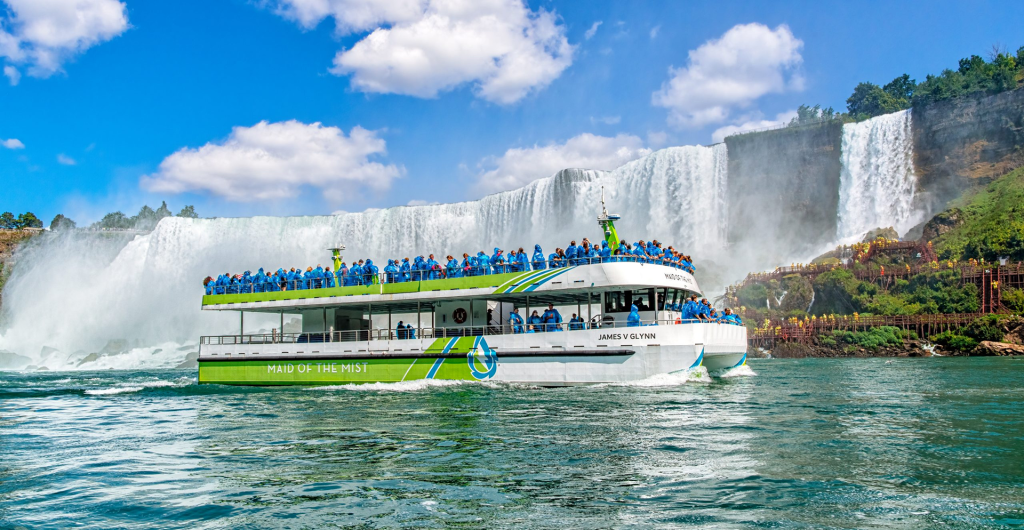
While visitors come to the State Park to stand beside the Niagara River, ride the Maid of the Mist, descend toward the Cave of the Winds, photograph the Falls, and spend money on hotels, restaurants, parking, attractions, and souvenirs, just beyond all the sights and sounds, there is another Niagara Falls where a quarter of the population lives below the poverty line.
The median household income of the city of Niagara Falls is about $49,000, and the population continues to decline. Streets and neighborhoods show the accumulated effects of decades of disinvestment, industrial loss, and a municipal tax base that has never seemed commensurate with the extraordinary economic asset sitting at the city’s doorstep.
No matter how you look at the numbers, the city is not capturing the tourism dollars to any serious extent.
Destination Niagara USA reports that tourism generates more than $1 billion in annual visitor spending across Niagara County. Census data shows that accommodation and food-service sales in the City of Niagara Falls alone exceeded $560 million in 2022, for example. Yet the city still struggles with poverty, deteriorating infrastructure, vacant properties, and limited resources for neighborhood reinvestment.
The mighty Falls themselves are located within a New York State park. The casino operates on sovereign Seneca Nation territory. A significant portion of the hotel tax revenue is dedicated by law to tourism promotion and transportation. Each of those arrangements has a legitimate purpose. But taken together, they raise a larger question that Niagara Falls has never fully answered: how much of the enormous economy created by the Falls actually becomes durable wealth for the host city?
For decades, Niagara Falls has pursued projects. Urban renewal cleared blocks. Convention facilities changed. Hotels were built. Casino gaming arrived. The state invested heavily in Niagara State Park and downtown. Main Street has repeatedly been targeted for revival. New proposals again promise transformation. Some have succeeded; others have disappointed. But the city’s underlying economic condition remains stubbornly familiar.
Perhaps the problem is that Niagara Falls has too often measured success by what gets built rather than what gets captured.
A hotel is valuable, but how many of its dollars remain in the community? A tourist attraction is valuable, but does it encourage visitors to walk into the surrounding commercial districts? A state investment is welcome, but does it expand the city’s taxable economy? A new project may create construction jobs, but does it create permanent careers, local ownership, and spending that circulates through Niagara Falls after the ribbon is cut?
Those are the measurements that should define the next era of economic development. Imagine increasing the amount each visitor spends in the city by only $25. At nine million visits, that represents a theoretical $225 million in additional economic activity.
It would also help to increase the length of stay by visitors. Give visitors reasons to explore Main Street, Pine Avenue, the Niagara Gorge, cultural attractions and neighborhoods beyond the immediate State Park. Create more locally owned restaurants, retail, entertainment and experiences capable of capturing those dollars. The opportunities become enormous without attracting a single additional visitor.
Niagara Falls needs an economy that extends beyond tourism. The city became an industrial powerhouse because it converted its natural advantage—abundant hydroelectric power—into jobs, factories and investment. The modern equivalent may involve advanced manufacturing, technology, data infrastructure, energy-intensive industries, and other employers capable of producing year-round, higher-wage jobs. Tourism should be an economic foundation, not the entire economic engine.
This is why the debate over Niagara Falls’ future should be larger than any mayor, council, developer, or individual project. That is why various projects, redevelopment, housing, infrastructure, and tourism should not exist as disconnected political battles. All should be evaluated against one common objective: will this grow the economy?
For generations, Niagara Falls has possessed an asset that cannot relocate, close its doors or move south. The waterfall is not leaving. The visitors are already coming. The world already knows the name.
This makes the persistence of poverty more than unfortunate. It makes it an economic failure that demands explanation.
The next chapter of Niagara Falls should therefore begin with a different question. Not how do we attract more tourists, and not what project do we announce next, but how do we convert the extraordinary wealth-generating power of Niagara Falls into lasting prosperity for the people who actually live here?
Until Niagara Falls solves that problem, nine million visitors a year will remain one of the most remarkable economic opportunities in America—hiding in plain sight.