Lake Sturgeon Seen Making Modest Rebound
By Frank Parlato
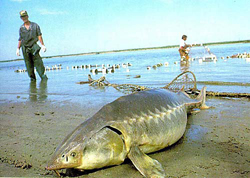 |
| The Sturgeon averages 4 feet and 65 lb. They can grow up to 9 feet and 300 lbs. |
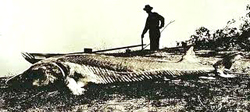 |
| In the late 19th century, an average of 4 million pounds of sturgeon were caught in the Great Lakes. |
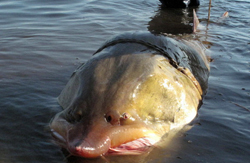 |
| Caviar inside a Sturgeon fish may constitute 33% of their body weight. |
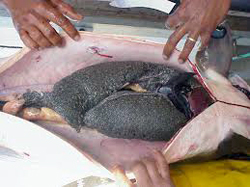 |
| Roe inside a sturgeon. |
 |
| The sturgeon has made a reappearance in the Great Lakes. |
The lake sturgeon - with only about one percent of its pre-1850 population - is making - for the first time in perhaps more than a century -a modest rebound.
Recently, researchers recorded observations of natural recovery in the Great Lakes, the Niagara River and the St. Lawrence.
Little more than a year ago, egg-bearing females were detected in stocked locations in New York.
This summer, researchers captured two wild juvenile sturgeon in two locations, causing DEC Commissioner Joe Martens to exclaim, "This is a truly significant event."
Among the most primitive of fish, the lake sturgeon appeared during the Upper Cretaceous period, when dinosaurs thrived and the Earth had one continent.
Adults, averaging four feet and 65 pounds, can grow to nine feet and 300 pounds. The life-span is 55 years for males and 80 to 150 years for females.
An ancient bottom feeder, the fish uses its spade-like snout to stir up sediment on beds of rivers and lakes eating insect larvae, worms, leeches, crayfish, snails, clams and other organisms it finds in the mud.
Females spawn once every 4 to 9 years. Males every 2 to 7 years.
They migrate as much as 80 miles upriver, to return to the shoals and streams where they were born, in shallow, swift waters.
Females lay up to 800,000 eggs - males drop milt to fertilize - and the eggs scatter and adhere to rocks and logs.
The fry hatch in a week then drift downstream.
Some remain in their natal rivers for their first summer of life.
In the first half of the 19th century, fisherman seeking whitefish began to net lake sturgeon. Too fatty and rank to eat, and destructive of gear, they were killed and piled on shore to burn for fuel or fed to pigs.
In the 1860s, it was discovered that smoking the sturgeon reduced its oiliness and made it tasty. Smoked fish was sold.
But the real bonanza came when a market was discovered for the roe inside the female lake sturgeon, which was sold for caviar.
The choicest caviar comes from roe plucked from a live fish. Stunned then slit while alive, the ovaries were removed and emptied of their contents. Up to a third of an adult female sturgeon’s body weight can be roe – a harvest of 70 pounds from one fish was not uncommon.
From 1879 to 1900, the commercial catch of lake sturgeon in the Great Lakes averaged 4 million pounds. Starting in the 1890s the decrease in each year’s catch was rapid. It took man 50 years to wipe out a fish that thrived for 136 million years.
From 1900 to the 1970s, little is known about lake sturgeon populations, except for their continued decline.
On top of overfishing, the damming of tributaries prevented access to historical spawning grounds; siltation from deforestation, agriculture, dredging, and pollution also hindered reproductive success.
The lake sturgeon is still found in freshwater lakes and rivers in northeastern North America.
In New York, lake sturgeon have been collected in St. Lawrence River, Niagara River, Oswegatchie River, Grasse River, Lake Ontario, Lake Erie, Lake Champlain, Cayuga Lake, and the Seneca and Cayuga canals.
Lake sturgeon is listed as Endangered, Threatened, or Special Concern in 19 of 20 states throughout its range.
The state DEC is using artificial propagation to re-establish populations in tributaries of Lake Ontario and the St. Lawrence, including the Oswegatchie River, Black Lake, the St. Regis River, Oneida Lake and Cayuga Lake and released more than 65,000 juvenile Lake Sturgeon since 1995.
And after nearly two decades, they are just beginning to see signs of success.
The sturgeon is still present in Quebec in the St. Lawrence, where it is targeted by commercial fisheries. It is probably the only place where it is fairly common to catch one as a game fish where there is a harvest limit of one per day.